/dev/world 2026 wrap-up
28 August 2026
I had the happy opportunity to attend /dev/world again this year and connect and reconnect with a bunch of developers. It’s such a good-natured group and it’s been inspiring to see lots of participation from students this year. When the industry is evolving faster than ever, it’s oddly reassuring to have continuity of community.
Ostensibly /dev/world is a conference for developers on Apple platforms, but it’s always been a little broader than that, and this year was no exception. The keynotes were about career and life. We had adjacent technical topics like Kubernetes and security, and much more AI than previously.
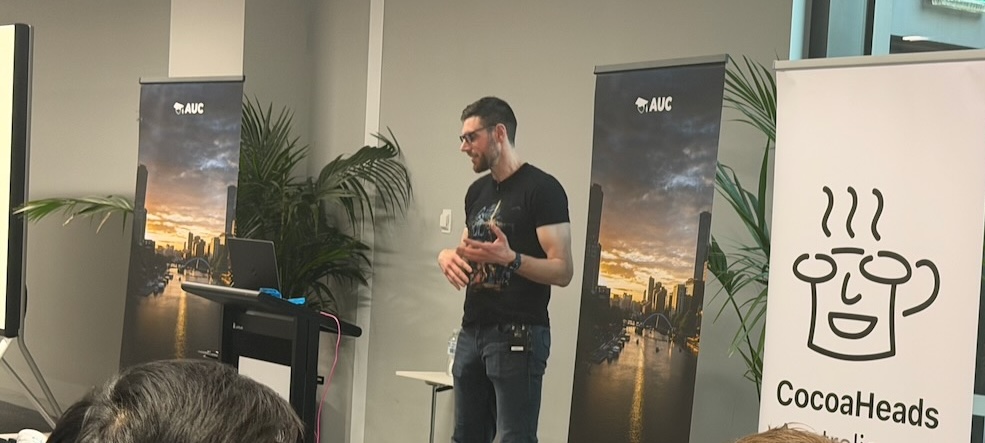
Nic Wittison speaking about agentic AI development
One of my favourite parts was a series of presentations by students at RMIT. Some of them have done a short intensive course on app design and development—only a few weeks!—while others are studying it as a four-unit minor. These young people did a fantastic job. They found a human-focused problem where an app could help, did their research, and tried their best to develop an app that really meets the target user where they are. It also happened to be student groups who showed the most sophisticated engagement with AI/ML at the conference—creating custom forecasts and dramatically improving the performance of a small Qwen model for local inference via DoRA fine-tuning.
Toby Duffy is the creator of PreviewAR, an app used by many TV and movie producers when scouting outdoor locations where they intend to film. They can take photos and videos with custom 3D models inserted into the scene using Apple’s augmented reality framework, ARKit. He gave a fascinating talk about the problems that arise when creating large-scale AR scenes outdoors, noting that most of the existing samples and work assume you’re in a room. He said that one support request involved a user having trouble placing a model for a full-sized stadium in their scene—to my disappointment, I later confirmed that this wasn’t someone assessing the viability of the Hobart stadium.
What I’d really like is a Woolworths AR application that helps me find the aisle with the weird ingredient on my shopping list. A man can dream.
Josh Deprez spoke about Kubernetes, reframing it as a common language for describing the infrastructure and services you need when running highly available distributed software. The shared understanding this creates is almost more useful than the specific software. They used examples from their home lab of Raspberry Pis running K3s, hosting a web service over multiple nodes. Over lunch I inquired about high availability—apparently they are now using a system called MetalLB in which the Pis advertise BGP routes to the service IP, so if one node goes offline then new requests follow one of the remaining routes. BGP on a home LAN. Wild.
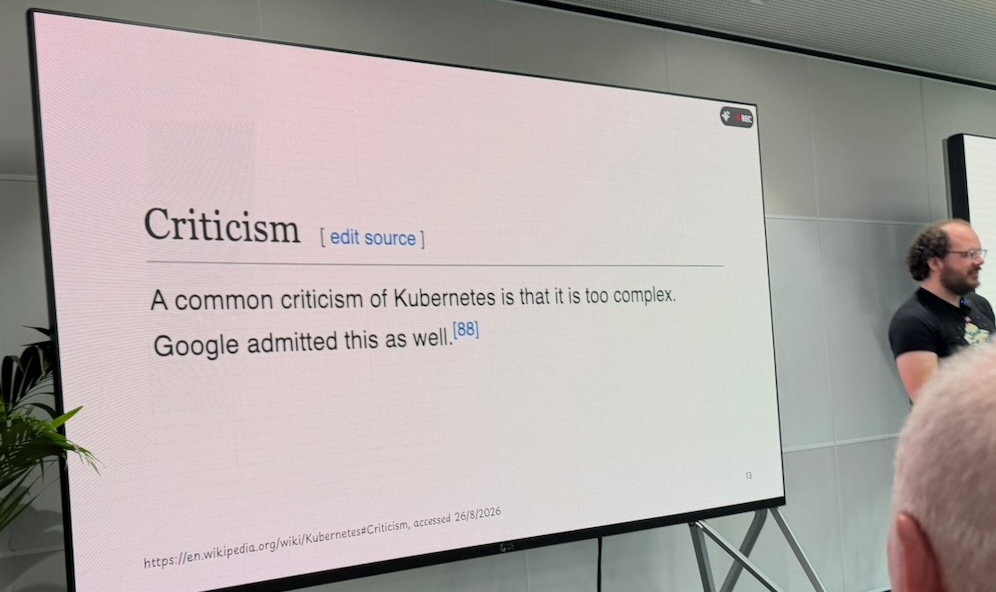
Josh Deprez speaking about Kubernetes
William Taylor gave a wonderful talk about using Swift for sharing business logic across iOS, Windows/C# and WASM at Drawboard. Like most other companies in this situation, they reasoned for a long time that C++ was probably the best fit. Unlike most other companies, they were sufficiently committed to their dislike of C++ to hold out until one day Swift became viable, with the official support for WASM landing in 6.2 last year. This is familiar territory to me—I’ve been using Swift on Linux and embedded Swift in WASM recently at work. It’s cool to see that it’s solving problems for other people too. In the past I’ve used Rust extensively for cross-platform logic, but unless you really need Rust’s performance or libraries, I can see Swift being a more developer-friendly language, especially if your team doesn’t already know Rust.
Now, let’s talk about AI. There were four or five talks in the main schedule that dealt with this topic substantively, with a range of opinions. I saw Claude/Codex running on a few people’s laptops (including my own) across the two days. It was a common topic in conversations. As far as I noticed, everyone managed to stay cool and normal about things, which is good. While I imagine a few delegates would prefer if AI just disappeared, I’m grateful that /dev/world has evolved into a conference where folks can be enthusiastic (usually with caveats), share worries out loud, experiment and develop with the technology on various axes, and examine the implications for cybersecurity. It’s a contentious topic, and having humans in the same physical space inspires a certain amount of good-faith decency that rarely extends to microblogging. There aren’t many venues for Australian software developers to have that in-person experience, so I’m glad this was one.
On a more critical note, I recognised the (undeclared) work of Claude in the slides of at least three presentations. I’m not out to embarrass anyone in particular, but suffice to say the end result would have been better without it. I’d much rather see extremely simple slides in the presenter’s own voice than a clichéd visual design, overcomplicated infographics, or Claude’s verbal tics.
For those who did want to hear about AI, we had plenty of choice. Ace Authors gave a great technical overview of the requirements and parameters of local inference, taking this all the way up to running MLX models over a cluster of Macs. It turns out this requires a lot of network bandwidth. Nic Wittison described his newfound productivity, noting that you only get slop if you allow slop and explaining how his experience as an engineering manager and structured tools like Open GSD help him get good outputs. Harry Ng explored how you teach and assess programming in a world where AI is able to write the code. Louis Cremen highlighted how AI can enable attacks both by finding existing vulnerabilities and by becoming a vulnerability itself when it can be tricked into performing actions against its owner’s interests. Cryptographic context injection is wild. Daniel Steinberg touched on AI in his keynote, in which he reminded us all to breathe and make time for the humans in our lives. Always good advice.
It was Nic who had the quotes of the day.
“If you feel it just makes slop, use your expertise and stop letting it make slop.”
“If fixing mistakes is cheap, it might be worth reframing what your tolerance for mistakes is.”
Great event, everyone. See you next time, I hope!
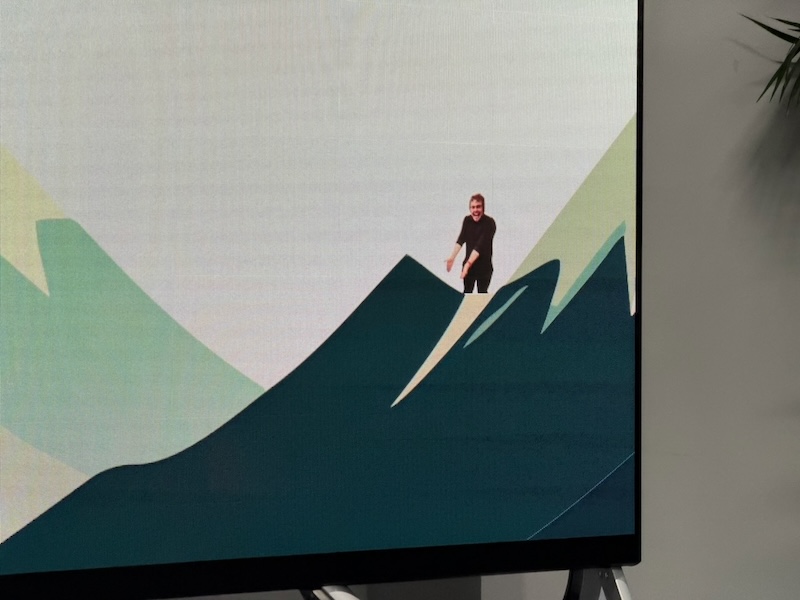
Obligatory Tim in Judit’s keynote
Serious Computer Business Blog by Thomas Karpiniec
Posts RSS, Atom